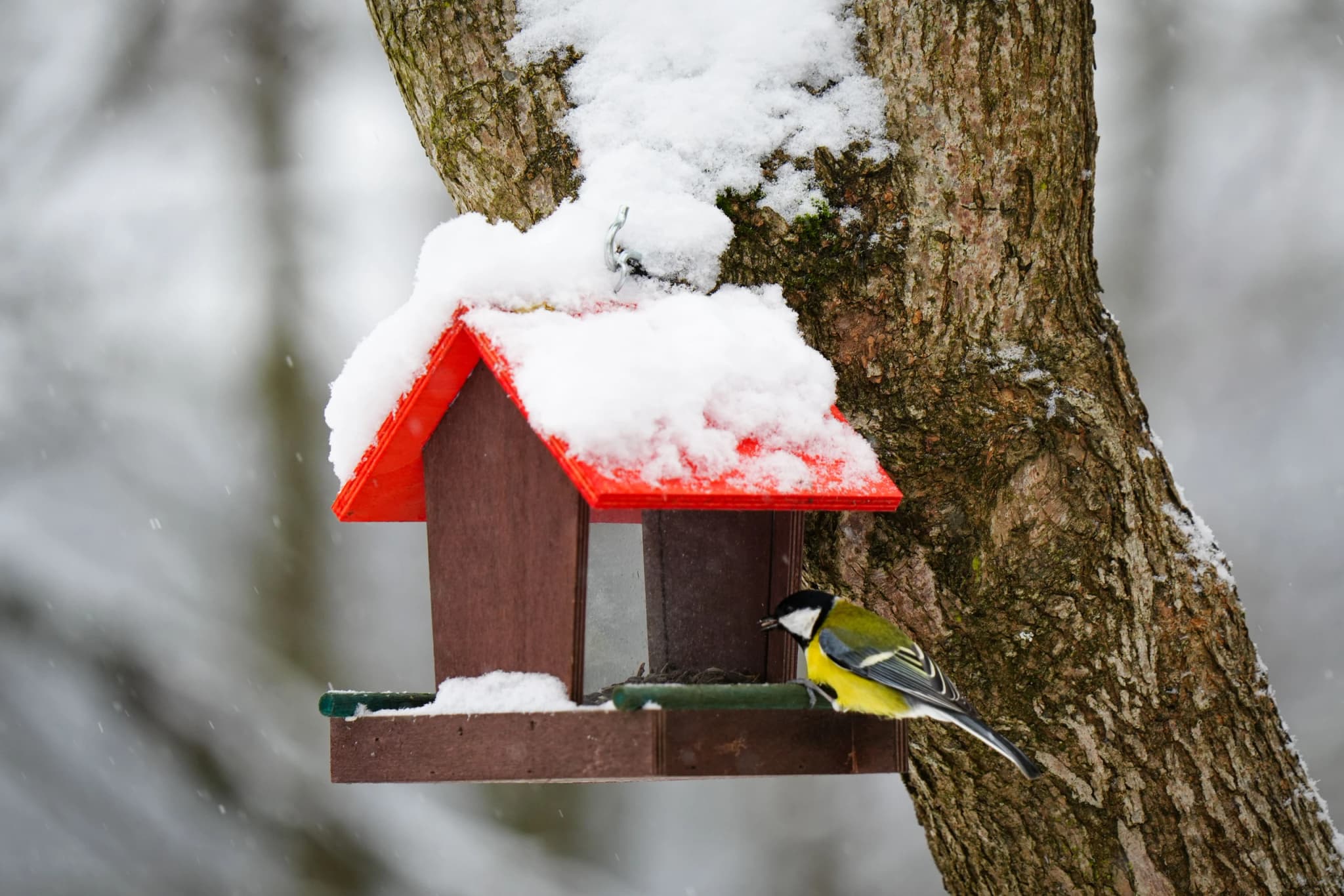

Who are the most frequent guests in the garden in winter?
The most numerous visitor to the food house in Estonia is the great tit with a yellow belly and a black crown, which is often accompanied by the smaller blue tit with a light blue crown. Among the seed eaters, the greenfinches with their strong beaks stand out, joined by the red-breasted males and the more modest grey-brown-feathered females.
In the vicinity of the food house, you can often see field and house sparrows, which usually work in flocks, and the woodpecker with a blue-gray back and rusty belly, which is the only Estonian bird that can move upside down on a tree trunk. In addition, the gardens are visited by great spotted woodpeckers, siskins, and blackbirds, which search for apples and berries that have fallen from the ground in winters with less snow.
When and how to start and stop feeding birds?
It is wise to start supplementing with food only when the persistent cold has lasted for a few weeks or the ground is covered with a thick blanket of snow. Feeding too early can have a negative effect on the migratory birds' instinct to leave and leave them here to winter. In warmer periods, birds find enough food in nature, but during periods of alternating frost and thaw, extra energy is a great help to birds.
Once started, feeding should be continued until spring, as the unexpected loss of food in the middle of a harsh winter can be fatal for birds. It is worth putting out a portion of food every day at a fixed time, as the birds quickly get used to the rhythm, arrive on time and the food does not get stuck under the snow. In spring, the quantities are gradually reduced over a couple of weeks and feeding is stopped no later than April, when insects and seeds are again available in nature.
What foods to offer to garden birds?
The most versatile and nutritious choices are thin-shelled sunflower seeds, or slivered ones, and unflavored suet, which are appreciated by almost all garden birds. In addition, flax, rapeseed, pumpkin, and pine seeds, as well as unsalted peanuts, are also excellent for seed eaters.
For tits, woodpeckers and woodpeckers, pure lard is an excellent source of energy. Birds with stronger beaks will eat grains in addition to seeds, such as oatmeal, millet, groats, buckwheat or corn, which can be prevented from freezing by adding a drop of cooking oil. For variety, you can offer seed mixtures intended for caged birds, boiled eggs, soft cheese or fatty minced meat, while for thrushes, apples, berries and soft vegetables left on trees, such as boiled potatoes, can be offered.
What should be kept off the bird's diet?
When choosing food, there are two simple rules: the food must be completely unflavored and as dry as possible. Pieces with a high water content tend to freeze in minus degrees and become inaccessible to birds, while in plus degrees they spoil quickly. Salty and spicy foods are especially unsuitable, including regular bread. Spoiled food should also not be given to birds.
How to serve food correctly?
In addition to the choice of food, the structure of the feeding area determines the well-being of birds. Fat balls can be offered as a titmouse bell or in a cup attached to a stand, while peanuts should be hung with a net or in a special feeder. It is also convenient to hang pieces of lard so that the birds can easily access them and the food remains free of snow. In the case of birdhouses, it is worth ensuring that larger winged birds, such as crows, magpies or pigeons, do not eat the food for garden birds or scare them away from the feeding area. Narrower entrances and separations with sticks, which prevent larger birds from accessing the food, help to prevent such situations. It is important to ensure that the daily amount of food is uniform and not too large, so that the birds have time to eat the food displayed before it is buried under the snow.
From sources
The article is based on information materials from the Estonian Ornithological Society.